

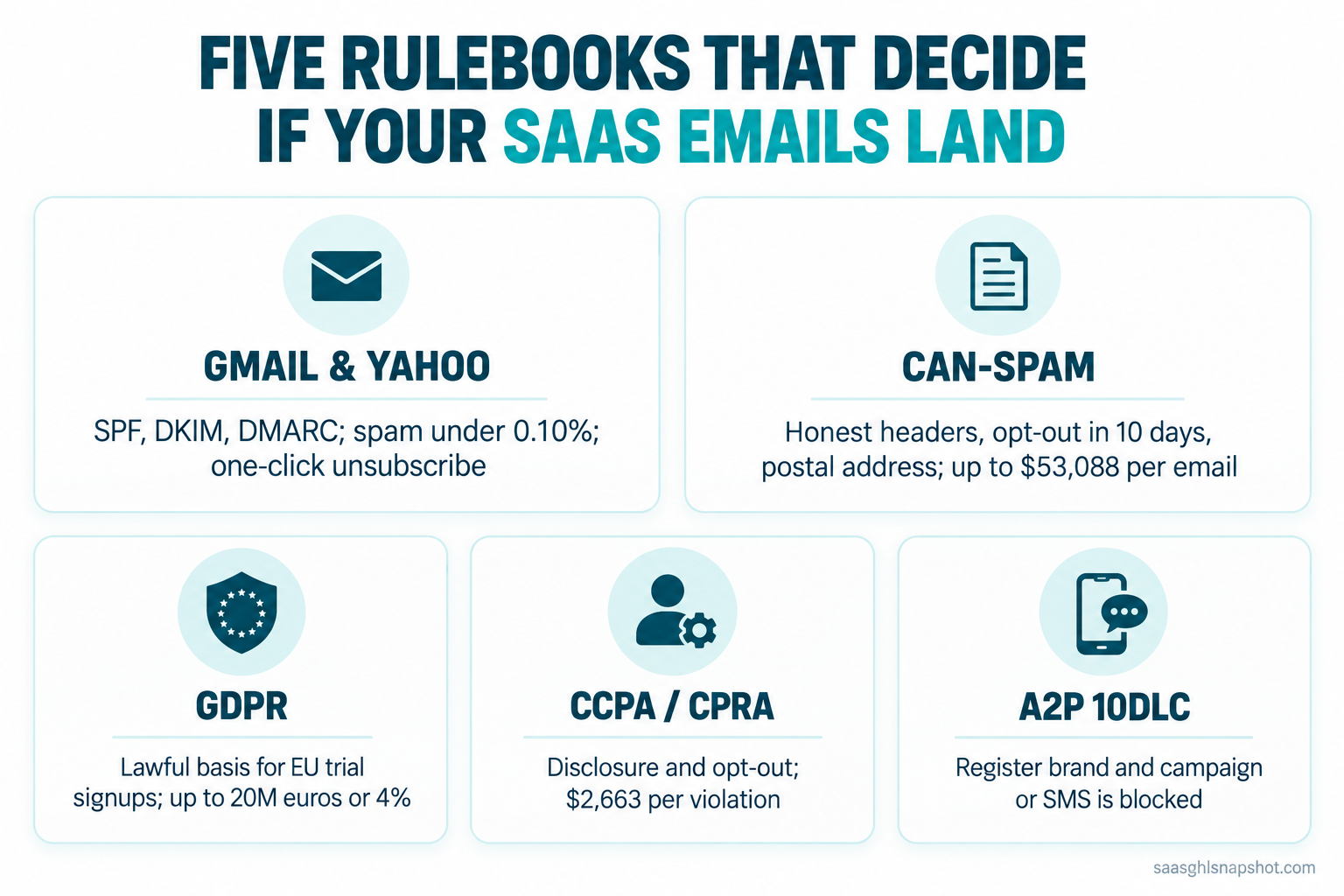
If your trial emails, activation nudges, and failed-payment notices do not reach the inbox, none of your lifecycle work matters. In 2026 five rulebooks decide whether they land: the Gmail and Yahoo bulk-sender rules from February 2024, the US CAN-SPAM Act, GDPR for anyone in the EU, California’s CCPA as amended by CPRA, and A2P 10DLC if you text. Get the plumbing right once (SPF, DKIM, DMARC, a real unsubscribe, a lawful basis, a postal address) and you are both compliant and far more likely to hit the inbox. Get it wrong and you pay for emails nobody sees, or pay fines. This is the checklist, the costs, and the copy you can paste today.
Key takeaways
Table of contents
- Why deliverability is a compliance problem now
- What getting it wrong costs
- The five rulebooks at a glance
- Rulebook 1: Gmail and Yahoo sender rules
- Rulebook 2: CAN-SPAM
- Rulebook 3: GDPR for EU trial signups
- Rulebook 4: CCPA and CPRA
- Rulebook 5: A2P 10DLC if you text
- Where this breaks
- Three scenarios: solo, five-person, fifteen-person
- Copy you can steal
- Objections
- FAQ
- Sources
Why deliverability is a compliance problem now
It is a Tuesday and your trial-ending sequence just went out to 1,400 people. Open rate is half what it was last month. You check a seed inbox and there it is, in spam, dunning emails too. That failed-payment card you counted on recovering this week never got a nudge, because the customer never saw it.
For years, deliverability was treated like dark art. In February 2024 Google and Yahoo ended that. They published hard requirements for anyone sending in volume, and those requirements are the same things that keep you legal: own your domain, make unsubscribing trivial, keep complaints low (Gmail, Yahoo).
So you do not have two problems. Do the checklist once and your trial-to-paid sequence, your failed-payment dunning, and your activation emails all land better. Skip it and you lose revenue twice, once to the spam folder and once to a regulator.
What getting it wrong costs
Two kinds of cost. The first is quiet: email that does not land. If your trial-ending email hits spam the trials expire; if your dunning email hits spam the failed payment stays failed. You already paid to acquire that customer, and CAC payback has slowed, up 12.5% at the median since 2022 (Benchmarkit 2025 B2B SaaS Benchmarks), so recovery email rotting in spam costs you in a way that never shows up as a line item.
The second cost is loud. The real ceilings:
CAN-SPAM should make you sit up, because it is charged per email. The FTC sets the maximum at $53,088 for each separate email in violation, raised in its January 2025 inflation adjustment (FTC CAN-SPAM guide, Federal Register). Nobody expects the maximum, but you do not want to be the test case. Your list grows every month, with small B2B SaaS up a 22% median in 2026 (SaaS Capital), so fix the plumbing while it is small.
The five rulebooks at a glance
The whole map; each row is detailed below.
| Rulebook | Who it binds | Core requirement | Cost of ignoring it |
|---|---|---|---|
| Gmail and Yahoo | 5,000+/day to their inboxes | SPF, DKIM, DMARC; spam under 0.10%; one-click unsubscribe | Filtered to spam or rejected |
| CAN-SPAM | Every commercial email, B2B too | Honest headers, opt-out in 10 business days, postal address | Up to $53,088 per email |
| GDPR | Any email to a person in the EU | Lawful basis, easy opt-out, data-access rights | Up to €20M or 4% of turnover |
| CCPA and CPRA | California residents (at threshold) | Disclosure, opt-out of sale/share, deletion | $2,663, or $7,988 if intentional |
| A2P 10DLC | US SMS from a 10-digit number | Register brand and campaign via TCR | Blocked (error 30034), still billed |
Three of these (Gmail/Yahoo, CAN-SPAM, A2P 10DLC) you set up once. Two (GDPR, CCPA) are about how you collect consent, so they touch your signup form and CRM, not just your email tool.
Rulebook 1: Gmail and Yahoo sender rules
Gmail and Yahoo deliver most of the inboxes you care about, so this one changed the game. Since February 2024, if you send roughly 5,000 or more messages a day to Gmail addresses from the same domain, you are a “bulk sender” and the following are required, not optional (Gmail sender guidelines, FAQ). Yahoo publishes aligned requirements.
Authenticate your domain with all three records. SPF says which servers may send for you, DKIM signs each message so it cannot be tampered with, and DMARC ties them together and tells receivers what to do on a failure. DMARC can start at p=none, which only monitors, so there is no excuse to skip it. Your platform gives you the exact DNS records to paste. An afternoon, not a project.
Keep your spam complaint rate low. Google is explicit: keep the user-reported rate below 0.10%, and never let it reach 0.30%. From June 2024, bulk senders over 0.30% are not even eligible for mitigation, and Yahoo uses the same ceiling. One email to a cold list can spike it for weeks.
Make unsubscribing a single click. Marketing mail must include one-click unsubscribe per the RFC 8058 standard: a List-Unsubscribe header plus a List-Unsubscribe-Post header, so the client shows an “Unsubscribe” link at the top with no landing page (RFC 8058). You then act within 2 days. Transactional mail (a receipt, a password reset) is exempt; your lifecycle sequences are not.
Under the 5,000-a-day line? You still need SPF or DKIM, and should do all three plus one-click unsubscribe anyway, because it is the biggest lever on whether a small sender lands. It is the compliance layer under running lifecycle email without Customer.io Premium.
Rulebook 2: CAN-SPAM
CAN-SPAM is the US federal law on commercial email, and the most common myth is that B2B is exempt. It is not. If the message’s primary purpose is commercial, it applies. The FTC’s rules are short and testable (FTC compliance guide):
- No false or misleading headers. The “From” and routing info must identify who actually sent it.
- No deceptive subject line. The subject has to reflect the content.
- Say it is an ad if the message is one. A plain lifecycle nudge usually is.
- Give a real physical postal address. A PO box or registered agent address is fine. This trips up remote-first teams constantly.
- Honor opt-outs fast. Keep the unsubscribe working for at least 30 days after you send, and process the request within 10 business days. No fee, no forced login.
The ten-business-day window is generous next to Gmail’s two days, so build for the Gmail rule and you clear CAN-SPAM automatically. The one that bites people is the postal address, so put it in your footer now.
Rulebook 3: GDPR for EU trial signups
The part founders outside Europe get wrong: GDPR is not about where you are, it is about who the person is. The moment someone in the EU signs up for your trial, you are processing their personal data and GDPR applies, wherever you are based (GDPR, Art. 83). The ceiling is large: up to €20 million, or 4% of worldwide annual turnover, whichever is higher.
For a small SaaS running lifecycle email, the practical requirements are manageable:
- Have a lawful basis for each send. For your own trial users, legitimate interest or the contract usually covers service and onboarding email. Marketing to non-customers generally needs a real opt-in, not a pre-ticked box.
- Make withdrawal as easy as giving consent. Your one-click unsubscribe covers most of this.
- Respect data-access and deletion requests, which means knowing where trial data lives in your CRM.
- Say what you collect and why, in plain language, at signup.
You do not need a six-figure privacy program at $1M ARR. You need a lawful basis you can name, a privacy notice, and the ability to find and delete one person’s data. Build it into your lifecycle setup from the start and it costs almost nothing.
Rulebook 4: CCPA and CPRA
California’s equivalent is the CCPA, strengthened by the CPRA, whose provisions took effect in January 2023 (California Attorney General, CCPA). It applies once a business crosses certain thresholds (revenue, or volume of California residents’ data) that many growing SaaS companies hit. The core duties rhyme with GDPR: tell people what you collect, let them opt out of the sale or sharing of their data, and delete it on request.
The penalties were refreshed for inflation. As of 2025 they are $2,663 per violation, rising to $7,988 for an intentional one or one involving a consumer known to be under 16 (California Privacy Protection Agency). “Per violation” can mean per consumer, so these add up fast. The build is the same as GDPR: a privacy notice, an opt-out link, and a reliable way to delete a record. Do it once, satisfy both.
Rulebook 5: A2P 10DLC if you text
If your lifecycle includes SMS (trial reminders, dunning texts, appointment nudges), there is a separate US system you cannot skip: A2P 10DLC, the carrier registration for Application-to-Person messages from a standard 10-digit number. Since 2023 US carriers fully block unregistered A2P traffic, and the painful part is that a blocked message still bills you, returning error 30034 (Twilio A2P 10DLC overview).
Registration runs through The Campaign Registry: register your brand (who you are) and each campaign (the use case and sample messages), then attach your sending numbers. It takes a few days.
SMS consent rules are stricter than email: you need explicit opt-in, a clear “reply STOP to opt out,” and you must honor STOP immediately. Sample opt-in copy is below, and our SMS automation playbook covers the lifecycle side.
Where this breaks
Setup is the easy part. Here is where teams lose the inbox after they think they are done.
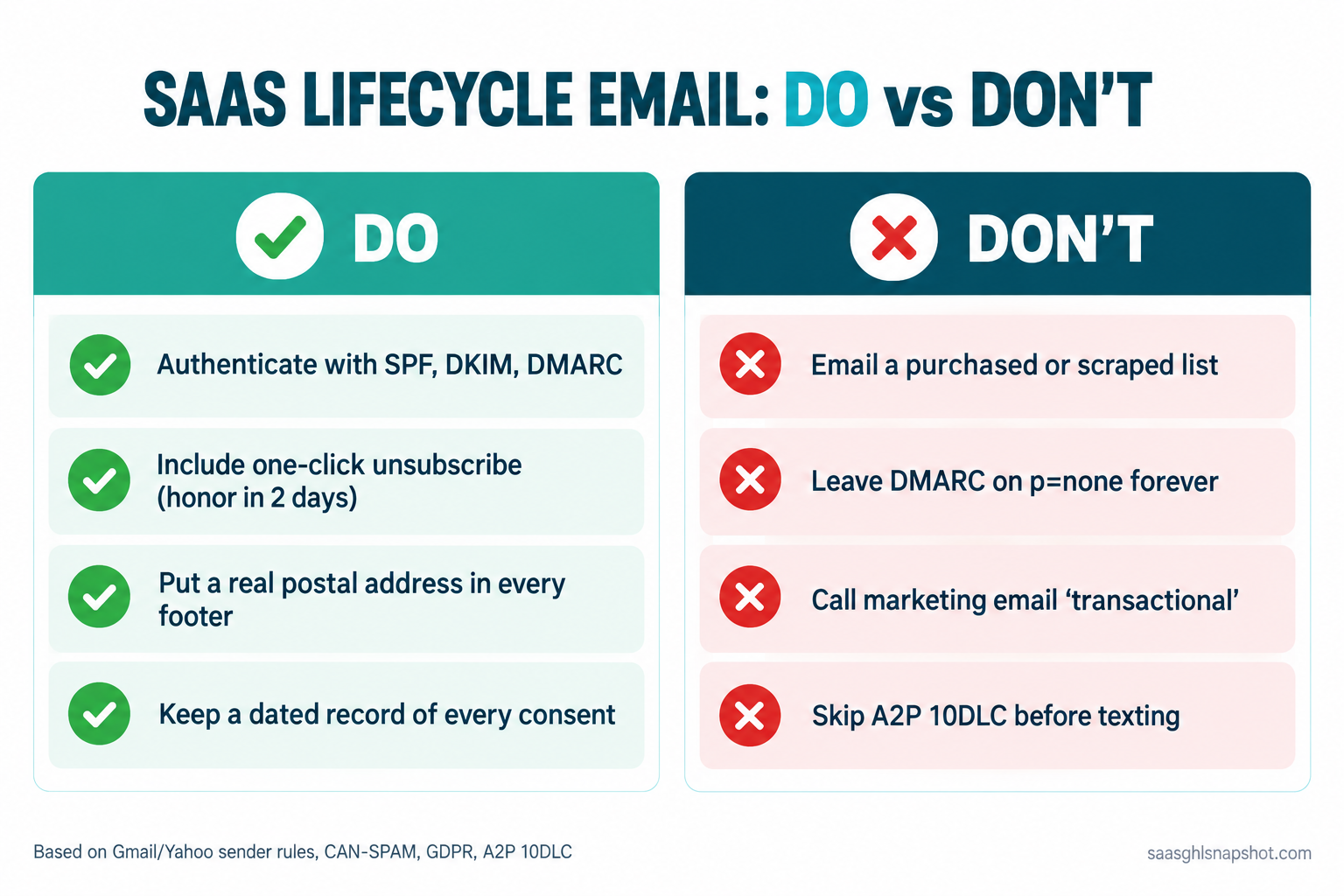
You send from a new domain with no warm-up. A brand-new domain has no reputation, so a sudden blast looks exactly like spam. Ramp volume over two to three weeks, starting with your most engaged users.
DMARC is set to p=none and left there forever. p=none only monitors. The failure is never reading the reports and never tightening to quarantine or reject, which leaves anyone free to spoof your domain and torch your reputation.
You buy or scrape a list. Nothing spikes your complaint rate like emailing people who never opted in. One cold campaign can push you past 0.30% and undo months of sending, and it fails CAN-SPAM and GDPR consent at once.
Your unsubscribe “works” but your CRM does not suppress. The link registers the opt-out, but a separate automation keeps emailing off a different field. Now you are emailing people who unsubscribed, a complaint magnet and a direct CAN-SPAM violation. Test the full loop, not just the link.
The postal address is missing from one template. You fixed the main template and forgot the dunning sequence built in another tool. Every email needs it. Audit all of them.
Three scenarios: solo, five-person, fifteen-person
The rules are the same; the right amount of effort is not. Here is the honest version for three stages.
Solo founder, pre-revenue to early trials. One domain, a few hundred people. You still must authenticate (SPF, DKIM, DMARC at p=none), still need one-click unsubscribe, a postal address, and a lawful basis. It is an afternoon in your email tool’s setup wizard plus three DNS records. Do not over-build: records and a privacy notice, not privacy counsel. If you text, register A2P 10DLC before your first SMS.
Five-person team, under $1M ARR. A bad week now shows up in open rates, and you probably have a few EU trials. Tighten DMARC past p=none once your reports are clean, and make sure every sending surface (marketing, transactional, dunning) carries the footer and shares one suppression list. This is where tool sprawl quietly creates two or three sending systems needing the same setup.
Fifteen-person team, $1M to $3M ARR. You are a bulk sender for real, you have California and EU customers, and prospects are asking about SOC 2. Deliverability is now a named responsibility: complaint rates watched per segment, DMARC at reject, a documented process for data-access and deletion requests. A spam-foldered dunning sequence at this scale is real churn, the metric that breaks the model.
Copy you can steal
Paste these, change the bracketed bits, and you clear most of CAN-SPAM, the Gmail unsubscribe rule, and the consent basics.
A CAN-SPAM-safe email footer, on the bottom of every lifecycle email:
You're getting this because you signed up for a [Product] trial on [date].
Not useful? Unsubscribe here: {{unsubscribe_link}}

[Company Legal Name]
[Street Address or PO Box], [City, State ZIP], [Country]
The one-click unsubscribe headers. Your platform may add these; confirm both are present on marketing sends. This is what satisfies Gmail and Yahoo.
List-Unsubscribe: <https://app.example.com/u/{{token}}>, <mailto:[email protected]>
List-Unsubscribe-Post: List-Unsubscribe=One-Click
Trial signup consent microcopy (GDPR and CCPA aware). Next to the signup button, not pre-ticked:
By starting your trial you agree to our Terms and Privacy Policy.
We'll send you product and onboarding emails. You can unsubscribe
from marketing at any time. We never sell your data.
An SMS opt-in line for A2P 10DLC. Capture this explicitly, store the timestamp:
Text updates from [Product]: reminders and account alerts. Msg & data
rates may apply. Reply STOP to opt out, HELP for help. Consent isn't a
condition of purchase.Objections
“We’re tiny and B2B, surely nobody cares.” Gmail’s filter does not know you are tiny and does not care that you are B2B. It filters on authentication and complaints, full stop. CAN-SPAM applies to B2B explicitly, and GDPR triggers on a single EU trial signup, not on headcount.
“Our email tool handles all this automatically.” Partly. A good platform sets up DKIM and adds the unsubscribe headers. It cannot choose your lawful basis, write your privacy notice, or stop you importing a purchased list. The tool handles the plumbing; the decisions are yours.
“Won’t the unsubscribe link cost us subscribers?” It costs you people who were going to complain anyway, the trade you want. A visible one-click unsubscribe lowers your spam-complaint rate, the thing Gmail actually measures. Hiding it just converts would-be unsubscribes into spam reports.
“We already pay for HubSpot or Customer.io, aren’t we covered?” On the sending mechanics, yes. Not on consent capture, your physical address, or a deletion request, because those touch your signup form and your data, not just the email tool.
Frequently asked questions
Common questions
Do the Gmail and Yahoo rules apply if I send fewer than 5,000 emails a day?
The strict bulk-sender requirements (SPF plus DKIM plus DMARC) kick in at roughly 5,000 messages a day to Gmail addresses. Below that you still need SPF or DKIM, and should set up all three plus one-click unsubscribe anyway, because for small senders it is the biggest lever on whether your mail lands. See Google's sender guidelines.
Is my trial-ending email transactional or marketing?
If it nudges someone to upgrade or buy, it is marketing, and it needs one-click unsubscribe and a postal address. Truly transactional mail (a receipt, a password reset, a security alert) is exempt. When a message does both, treat it as marketing and include the unsubscribe.
Does GDPR really apply to a US company with one EU trial user?
Yes. GDPR's scope follows the person, not the company, so processing the data of someone in the EU brings you in scope wherever you are based. For your own trial users, onboarding and service email usually rests on legitimate interest or the contract; marketing to non-customers generally needs consent. See GDPR Article 83.
Do I need A2P 10DLC if I only text a handful of customers?
Yes, if you send application-to-person SMS from a standard US 10-digit number, regardless of volume. Carriers block unregistered A2P traffic and the blocked message still bills you (error 30034). Register your brand and campaign through The Campaign Registry first. See Twilio's A2P 10DLC overview.
Is SOC 2 a legal requirement?
No. SOC 2 is a voluntary AICPA attestation, not a law, and you cannot be fined for lacking it. It becomes a practical requirement when enterprise buyers demand it before signing, so if you sell up-market, start the audit early because it takes months.
Compliance is not the glamorous part of growth, but it decides whether the rest of your lifecycle work reaches a human. Set the plumbing once, keep the complaint rate low, respect the unsubscribe, know your lawful basis. Do that and the Tuesday where your dunning emails sit in spam never happens, so the revenue you already earned shows up.
Sources
- Google Gmail sender guidelines and sender guidelines FAQ
- Yahoo sender best practices
- RFC 8058, one-click unsubscribe
- FTC CAN-SPAM Act compliance guide
- Federal Register, 2025 FTC civil penalty adjustments
- GDPR fines and penalties, Article 83
- California Attorney General, CCPA and CPPA updated monetary thresholds
- Twilio A2P 10DLC overview
- AICPA Trust Services Criteria (SOC 2)
- SaaS Capital, 2026 Private B2B SaaS Growth Rate Benchmarks
- Benchmarkit, 2025 B2B SaaS Benchmarks