
You do not need a first sales rep yet. You need the repeatable parts of your sales motion running without you. The honest signals you are ready to hire are a documented process you have run yourself, pipeline that has beaten your capacity for two quarters straight, and economics that can fund a full ramp plus a miss. Before all three are true, a hire is a bet of six figures in guaranteed cash on roughly a coin-flip. The cheaper move is to automate lead capture, qualification, booking, follow-up, and pipeline hygiene first, so you stay the closer. Here is the math and the six workflows to build first.
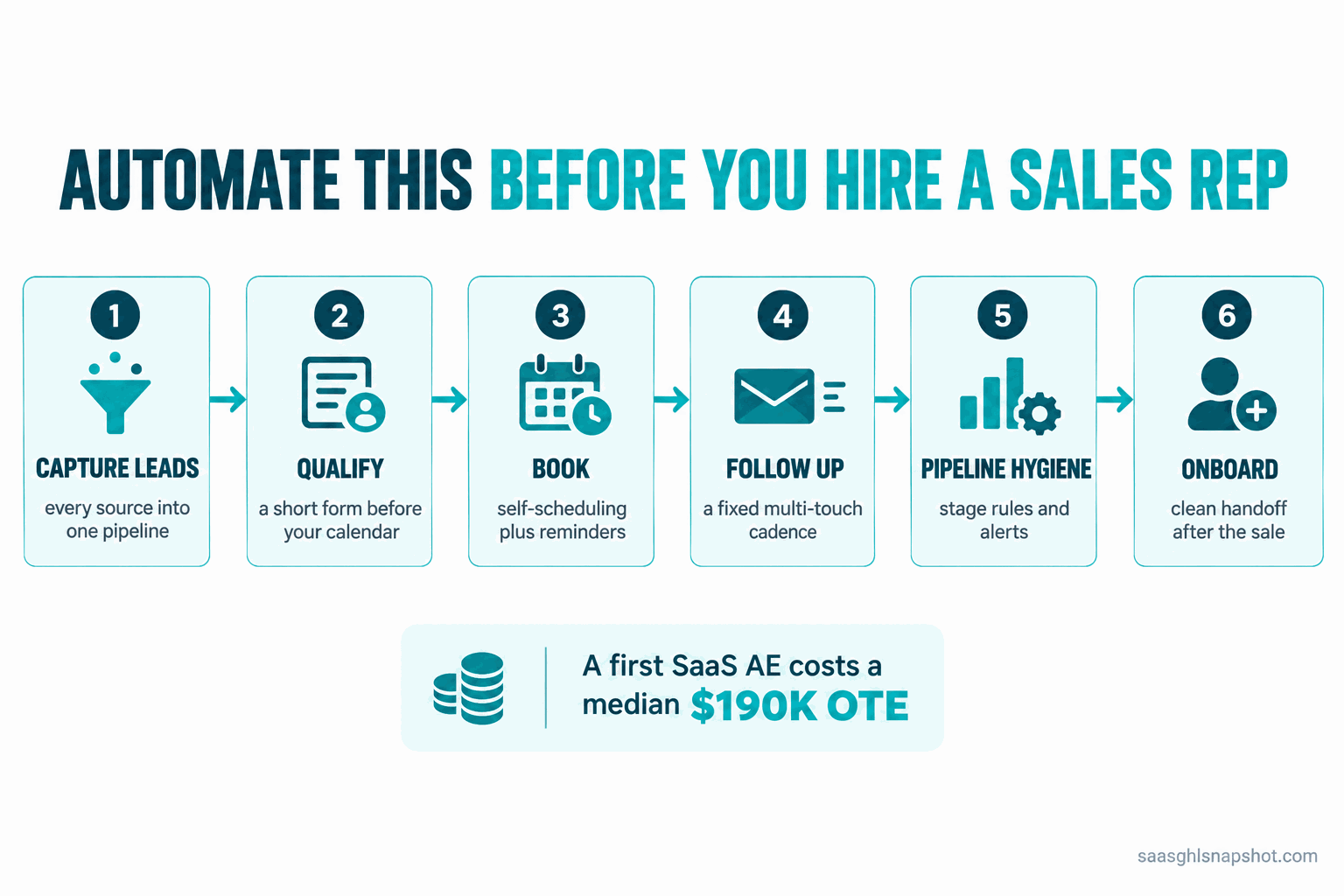
Table of contents
- What founder-led selling costs you
- What a first rep actually costs
- Three signals you are ready to hire
- Stage 1: Capture every lead
- Stage 2: Qualify before the call
- Stage 3: Book without back-and-forth
- Stage 4: Follow up on rails
- Stage 5: Keep the pipeline honest
- Stage 6: Hand off and onboard
- Run it at three growth stages
- The compliance layer
- Objections
- FAQ
What founder-led selling really costs you
Founder-led sales is your advantage until it is your ceiling. Your close rate beats any rep you could hire this year, but you are one person, and every hour chasing a form fill or rescheduling a demo is an hour you are not building or talking to your best customers. That ceiling shows up in the numbers: median growth for private B2B SaaS was 22 percent in 2026, down from 25 percent in 2024, and bootstrapped companies ran a median 20 percent (SaaS Capital, 2026 Growth Rate Benchmarks). When you are maxed out, the first instinct is to throw a body at the pipeline. It is usually the wrong move, and the next section shows why.
What a first rep actually costs: run the math
Price the hire honestly first. The median on-target earnings for a SaaS account executive hit $190,000 in 2024, up from $167,000 in 2022, on a 53:47 base-to-variable split (The Bridge Group, 2024 SaaS AE Metrics and Compensation). That split means about $100,000 in base pay you owe whether or not they sell a thing.
Now layer on reality. Only 51 percent of AEs hit quota in 2024, down from 66 percent in 2022, so you are paying that base on roughly a coin-flip. The average rep takes about 3.2 months to ramp, a quarter of base pay during which they close little. Add payroll tax, benefits, tooling, and the hours you spend hiring and coaching instead of closing, and real year-one exposure on one AE sits well north of $130,000, most of it fixed.
Annual cost, thousands USD. AE OTE $190K and SDR OTE $80K are 2024/2025 medians (The Bridge Group); the automation layer is a one-time build plus a year of a GoHighLevel subscription, roughly $4K. Illustrative, not like-for-like.
A sales development rep is cheaper, at a median $80,000 OTE in 2025 (The Bridge Group, 2025 SDR Report), but an SDR only books meetings, so they add pipeline to a founder who is already the bottleneck. The automation layer is the cheap side of the chart on purpose: a one-time build plus your platform subscription, a few thousand dollars against six figures of salary. Software does not replace a great rep; it lets you delay the hire until the economics are obvious and makes the rep more productive when they start.
The three signals you are actually ready to hire
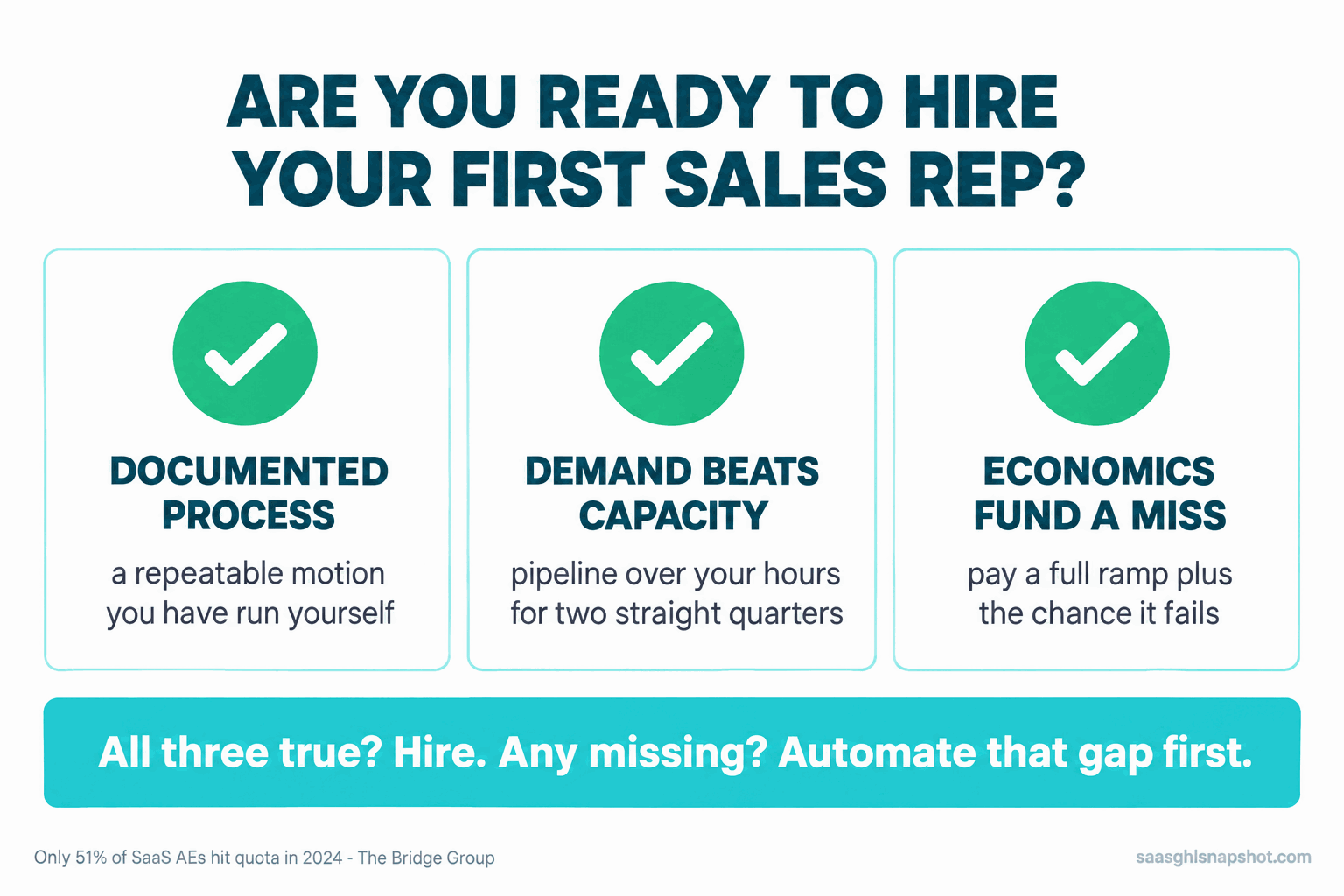
Forget “I’m busy.” Busy is a reason to automate, not to hire. Three gates actually mean the day has come, and all three must be true at once.
One: a documented, repeatable process you have run yourself. If it lives only in your head, a rep cannot run it, and you will spend six months translating instead of selling.
Two: pipeline has beaten your capacity for two quarters, not two weeks. A busy fortnight is noise; two quarters of qualified demand outrunning your hours is money a rep could catch.
Three: the economics can fund a full ramp plus a miss. CAC payback for B2B SaaS runs a median of about 16 months in 2026, down from 18 in 2024 (Benchmarkit via Pavilion, 2026 B2B SaaS Benchmarks). You need runway to pay a rep through ramp and absorb the real chance they wash out, because first sales hires fail often, around two-thirds inside 18 months (OpenView). If one bad hire would wreck your quarter, you are not ready.
The six stages below are how you tick that last box, worth building whether you hire this year or not. They are the machine a future rep inherits.
Stage 1: Capture every lead in one place
Leads arrive from a website form, a cold reply, a LinkedIn DM, a referral text, and a demo request, landing in five places. Some you answer in an hour, some a week later, some never. You cannot sell what you cannot see. Route every source into one pipeline the moment it arrives and fire an instant acknowledgement, so no lead sits cold and you buy time to reply properly.
The failure mode is a capture system that routes leads nowhere a human looks. A lead filed into a CRM nobody opens is worse than an inbox. Capture has to end in a visible task or alert.
Stage 2: Qualify before you spend a call
Your calendar is the scarcest resource in the company, and nothing drains it like demos with people who were never going to buy. Put a short qualification step before your calendar, so your live time goes only to prospects who fit. Ask three or four questions that predict fit, then branch: a good fit gets your booking link, a too-early lead gets a resource and a nurture track, an obvious non-fit gets a polite pointer elsewhere. You do this scoring in your head already; writing it as rules lets it run without you.
The failure is over-qualifying and strangling your own funnel. When you have ten leads a month, a form that scares off three is not discipline, it is self-harm. Keep the friction proportional to your volume, and loosen it the moment qualified bookings dip.
Stage 3: Book without the back-and-forth
The classic founder time sink is scheduling: three emails to find a slot, a no-show, a reschedule, another no-show. Hand it to software. A booking link kills the email ping-pong, and a reminder sequence kills most no-shows, which are usually a memory problem. Send a confirmation at booking, a reminder the day before, and a short one an hour out with the join link.
The failure mode is reminders with no easy reschedule. If the only options are show up or ghost, busy people ghost. Always give a one-click way to move the meeting, because a rescheduled call is a kept deal. See how to reduce SaaS demo no-shows for the deeper playbook.
Stage 4: Follow up on rails, not from memory
This is where founders lose the most revenue. You have a great call, say you will “send something over,” and the week swallows you. Two weeks later the deal is cold and you decide the prospect was not serious. They usually were, just busy, and you went quiet first. A written cadence takes the decision out of your tired evening brain: four specific touches over three weeks, each adding a new reason to reply, then a clean break-up note. Run it the same way every time so it is a system.
Roughly: day 2 re-anchors the price to the outcome they wanted, day 5 adds a proof point, day 10 addresses the objection stalling them (usually setup or switching cost), day 17 is a check-in with an easy out. The full version, with copy you can lift, is in the follow-up system for stalled ‘send me pricing’ deals.
The failure mode is sending “just checking in” four times. Repetition with no new information trains the buyer to ignore you, and that is what feels like spam. Every touch has to carry something new.
Stage 5: Keep the pipeline honest
Could you say right now what is in your pipeline and which deals are at risk, without digging through your inbox? For most founder-led teams, no, and a pipeline you cannot see is one you cannot forecast or hand off. Give each stage a one-line definition of what has to be true to sit there, so a deal cannot rot in “proposal sent” for a month. Then add a no-deal-left-behind alert: a deal with no activity for seven days surfaces on your task list. The CRM does the remembering so you do the selling.
The failure mode is a pipeline only you can read. When deal history lives in your head and your sent folder, you are the single point of failure: take a vacation and deals stall, try to hire and there is nothing to hand the rep. This is also where your CRM choice matters, one that saves sequences, enforces stages, and will not price you out.
Stage 6: Hand off and onboard so the sale sticks
The stage founders skip protects everything upstream. A closed deal is not revenue until the customer gets value and stays. If onboarding is a manual scramble, new customers churn early, and the day you hire a rep there is no clean handoff from “closed” to “onboarded.” Automate the post-sale sequence like the pre-sale one: a welcome that sets the first step, a scheduled kickoff, a nudge if they have not activated the core feature by day three, and a clear owner. The activation mechanics are in the trial-to-paid activation email sequence.
The failure mode is treating the signature as the finish line. A sale that onboards badly is a churn in waiting, and it quietly raises the CAC payback you are trying to cut. Close the loop from first touch to first value, and the whole funnel gets more efficient without a new hire.
Run it at three stages of growth
The six stages are the same at every size; what changes is how much you automate versus delegate, and whether a hire is on the table. Funding status matters as much as revenue: a bootstrapped team spends its own cash, a venture-backed one spends to prove a repeatable engine.
| Pre-revenue / solo | Under $1M ARR (bootstrapped) | $1M to $3M ARR | |
|---|---|---|---|
| Hire a rep? | No, still finding what repeatable means | Not yet; add an SDR to book, not an AE to close | Maybe, if all three gates are met |
| Automate first | Capture, booking, reminders | Add qualification and follow-up cadence | Add pipeline rules and handoff |
| Who closes | You, every deal | You, on automation-fed calls | You plus a rep on overflow |
| Readiness gate | Close ~10 customers yourself | Document the motion, beat capacity 2 quarters | Economics fund a ramp plus a miss |
| Biggest risk | Spending cash you lack | An SDR flooding a maxed founder | A premature AE inheriting chaos |
On the $1M to $3M column: hire only once the process is documented and the economics are real. Venture-backed teams there often hire two reps at once, because you cannot tell a rep problem from a process problem with a sample size of one (Jason Lemkin); bootstrapped teams hire one and lean on automation.
The compliance layer you set up once
Lead capture and follow-up run on email and sometimes text, both regulated. Set this up once and it protects every message the system sends. None of this is legal advice.
CAN-SPAM covers your sales and lifecycle email: a real physical address, a working unsubscribe, honest subject lines, and prompt opt-out handling (FTC CAN-SPAM guide). The Google and Yahoo bulk sender rules, in force since February 1, 2024, require SPF, DKIM, and DMARC, a spam complaint rate under 0.30 percent, and one-click unsubscribe at 5,000 or more messages a day (Google sender guidelines). Below that, authenticate anyway, because it keeps your follow-up out of spam. If any stage sends text, US carriers require A2P 10DLC registration and consent first. GDPR applies the moment an EU lead signs up, and CCPA and CPRA cover California residents.
The fastest way to kneecap your own pipeline is to switch on an automated sequence from an unauthenticated domain with no visible unsubscribe. Deliverability craters and your best follow-ups land in spam. Authenticate first, then automate.
Objections
“We’re busy enough, isn’t waiting just leaving money on the table?” Busy is the signal to automate, not to hire. If the repeatable work ran itself, most of your week would free up for closing. Hire when qualified pipeline beats your capacity after you have automated, or you are paying $100,000 to escape a problem software solves for a few thousand.
“What if I already pay for a CRM like HubSpot?” Use it. These six stages are a process, not a product, and any CRM that saves sequences, sets reminders, and enforces stages runs them today. If instead you are stitching together a form tool, a scheduler, an email app, and a per-seat CRM, consolidating onto one platform removes the gaps and cuts the bill.
“Won’t automated follow-up feel impersonal?” Only if it is generic. Automation handles the timing and reminders so you never drop a thread; you still write in your own voice and show up for the real conversations. Done right, buyers experience a founder who is impressively responsive, not a bot.
It is Tuesday and three leads are waiting
It is Tuesday. Two weekend demo requests are unanswered, a warm referral sits unread in a DM, and last week’s hot deal went quiet because you never sent the follow-up. The instinct is to hire someone to catch it. The cheaper fix is to build the machine that catches it for you, then hire from strength later, when a rep inherits a system instead of a mess.
Frequently asked questions
When should a SaaS founder hire their first sales rep?
When three things are true at once: a documented, repeatable process you have personally run, qualified pipeline that has beaten your capacity for two straight quarters, and economics that can fund a full ramp plus the real chance the hire fails. Being busy is not one of them. If the process only lives in your head, automate the repeatable work first.
How much does a first SaaS sales rep actually cost?
More than the salary line suggests. The median SaaS AE earns about $190,000 OTE (Bridge Group, 2024) on a 53:47 base split, so around $100,000 is guaranteed base. Add payroll tax, benefits, tooling, a ramp quarter where they close little, and your coaching time, and real year-one exposure runs well north of $130,000.
Should I hire an SDR or an account executive first?
Usually neither until the process is proven. An SDR (median OTE ~$80,000 in 2025) only books meetings, adding pipeline to a founder who is already the bottleneck. An AE only pays off once the motion is repeatable. Automate first; if you then add someone, an SDR is the lower-risk first move for a bootstrapped team.
What should I automate before hiring a salesperson?
Capture every lead into one pipeline, qualify before prospects hit your calendar, let them self-book with reminders, run a fixed follow-up cadence, enforce pipeline stages with alerts, and automate onboarding. These run the repeatable work without you and become the system a future rep inherits.
Is sales automation legal for cold and lifecycle email?
Yes, within the rules. CAN-SPAM requires a real address, a working unsubscribe, honest subject lines, and honored opt-outs. The Google and Yahoo bulk sender rules (since February 2024) require SPF, DKIM, DMARC and one-click unsubscribe at 5,000+ messages a day. If you text, US carriers require A2P 10DLC and consent first, and GDPR applies the moment an EU lead signs up.
Sources
- The Bridge Group, SaaS AE Metrics (2024) and SDR Report (2025): AE OTE $190K, 51% quota attainment, 3.2-month ramp; SDR OTE $80K
- SaaS Capital, 2026 Private B2B SaaS Growth Rate Benchmarks: median growth 22%, bootstrapped 20%
- Benchmarkit via Pavilion, 2026 B2B SaaS Benchmarks: CAC payback ~16 months; NRR 101%
- OpenView, Hiring Your First Sales Rep
- SaaStr (Jason Lemkin), When You Hire Your First Sales Rep, Hire Two
- FTC CAN-SPAM guide and Google sender guidelines
Related reading: the best CRM for founder-led sales in 2026, the follow-up system for deals that stall at ‘send me pricing’, how to reduce SaaS demo no-shows, and the CAC payback period explained.